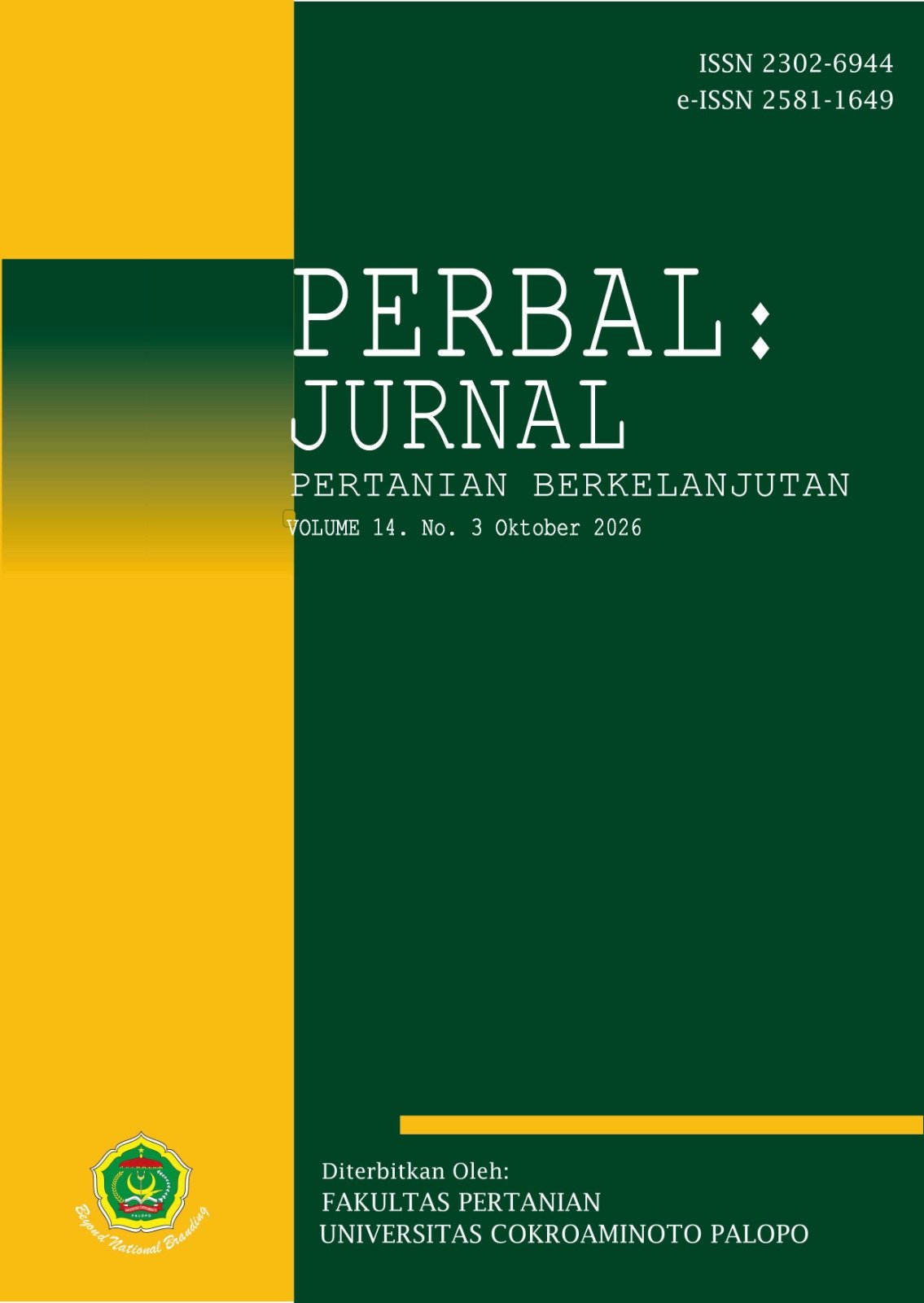
Pertumbuhan dan Produksi Mentimun pada Berbagai Jarak Tanam dan Dosis Pupuk Kandang Kambing
Growth and Yield of Cucumber at Various Planting Spacings and Goat Manure Dosages
DOI:
https://doi.org/10.30605/py4ssn86Keywords:
Mentimun, jarak tanam, pupuk kandang kambing, pertumbuhan, produksiAbstract
Mentimun (Cucumis sativus L.) merupakan salah satu komoditas hortikultura yang memiliki nilai ekonomi tinggi dan banyak dibudidayakan di Indonesia. Produktivitas mentimun dipengaruhi oleh berbagai faktor budidaya, di antaranya pengaturan jarak tanam dan pemberian pupuk organik. Penelitian ini bertujuan untuk mengetahui pengaruh berbagai jarak tanam, dosis pupuk kandang kambing, serta interaksi keduanya terhadap pertumbuhan dan produksi tanaman mentimun. Penelitian dilaksanakan pada bulan Maret sampai April 2026 di Desa Binabo Jae, Kecamatan Barumun, Kabupaten Padang Lawas, Sumatera Utara. Penelitian menggunakan Rancangan Acak Kelompok (RAK) faktorial yang terdiri atas dua faktor. Faktor pertama adalah jarak tanam yang terdiri atas 60 × 35 cm, 60 × 40 cm, dan 60 × 60 cm, sedangkan faktor kedua adalah dosis pupuk kandang kambing, yaitu kontrol (tanpa pupuk kandang kambing), 2 kg/petak (10 ton ha⁻¹), dan 4 kg/petak (20 ton ha⁻¹). Setiap kombinasi perlakuan diulang sebanyak tiga kali sehingga diperoleh 27 satuan percobaan. Parameter yang diamati meliputi jumlah daun, umur berbunga, jumlah buah per petak, panjang buah, diameter buah, bobot buah per petak, dan produksi per hektar. Data dianalisis menggunakan analisis ragam (ANOVA) dan dilanjutkan dengan uji lanjut apabila terdapat pengaruh nyata. Hasil penelitian menunjukkan bahwa berbagai jarak tanam maupun dosis pupuk kandang kambing tidak memberikan pengaruh nyata terhadap seluruh parameter pertumbuhan dan produksi mentimun. Interaksi antara kedua faktor perlakuan juga tidak menunjukkan pengaruh nyata. Secara numerik, perlakuan jarak tanam 60 × 60 cm dan tanpa pemberian pupuk kandang kambing menghasilkan rata-rata produksi tertinggi sebesar 18,567 ton ha⁻¹.
Cucumber (Cucumis sativus L.) is an important horticultural crop with high economic value in Indonesia. Crop productivity is influenced by several cultivation practices, including plant spacing and organic fertilization. This study aimed to evaluate the effects of different plant spacings, goat manure application rates, and their interaction on the growth and yield of cucumber. The experiment was conducted from March to April 2026 in Binabo Jae Village, Barumun District, Padang Lawas Regency, North Sumatra, Indonesia. A factorial Randomized Complete Block Design (RCBD) with two factors was employed. The first factor consisted of three planting spacings (60 × 35 cm, 60 × 40 cm, and 60 × 60 cm), while the second factor consisted of three goat manure rates (0, 2, and 4 kg plot⁻¹, equivalent to 0, 10, and 20 t ha⁻¹). Each treatment combination was replicated three times, resulting in 27 experimental units. Observed variables included number of leaves, flowering time, number of fruits per plot, fruit length, fruit diameter, fruit weight per plot, and yield per hectare. Data were analyzed using analysis of variance (ANOVA). The results indicated that plant spacing, goat manure application, and their interaction had no significant effects on all observed growth and yield parameters. Numerically, the 60 × 60 cm spacing without goat manure produced the highest yield of 18.567 t ha⁻¹.
References
Aini, N., & Muzakiyah, E. Z. (2023). Respons pertumbuhan dan hasil mentimun (Cucumis sativus L.) pada kombinasi media substrat dengan sistem hidroponik. Jurnal Hortikultura Indonesia, 14(2), 100–106. https://doi.org/10.29244/jhi.14.2.100-106 DOI: https://doi.org/10.29244/jhi.14.2.100-106
Aydın, A., & Başak, H. (2024). Morphological and pomological characterization of F2 generation cucumber (Cucumis sativus L.) plants of different fruit types. International Journal of Agriculture Environment and Food Sciences, 8(4), 932–943. https://doi.org/10.31015/jaefs.2024.4.23 DOI: https://doi.org/10.31015/jaefs.2024.4.23
Ayyubi, M. S. Al, Oktarina, & Widiarti, W. (2024). Efektivitas pemangkasan pucuk dan jarak tanam terhadap pertumbuhan dan produktivitas tanaman mentimun (Cucumis sativus l.). Callus: Journal of Agrotechnology Science, 2(1), 14–21. DOI: https://doi.org/10.47134/callus.v2i1.2073
Badan Pusat Statistik. (2024). Statistik Tanaman Sayuran Indonesia 2023. Jakarta.
Carlos, C. P., Megawati, S., & Wibowo, A. (2026). Peningkatan produktivitas dan mutu benih mentimun (Cucumis sativus L.) hibrida TJS-A01 dengan teknik pemangkasan pucuk dan pemeliharaan cabang. Jurnal Ilmiah Mahasiswa Agrokompleks, 5(2), 378–385. DOI: https://doi.org/10.29303/s1q5jq29
Dewi, W.W. (2016). Respon dosis pupuk kandang kambing terhadap pertumbuhan dan hasil tanaman mentimun (Cucumis sativus L.) varietas hibrida. Journal Viabel Pertanian, 10(2), 11- 29 DOI: https://doi.org/10.35457/viabel.v10i2.140
Laoli, D. E., & Najma. (2025). Pengaturan jarak tanam optimal untuk meningkatkan produktivitas tanaman hortikultura. PENARIK: Jurnal Ilmu Pertanian dan Perikanan, 2(1), 43–48.
Marsuhendi, R., Okalia, D., & Sasmi, M. (2021). The effect of providing a variety of candage fertilizer on the growth and. Jurnal Green Swarnadwipa, 10(2), 300–306.
Mas, R., Panjaitan, P., Parangin-angin, J. D., & Armawan, D. (2023). Pengaruh pupuk organik dan anorganik terhadap sifat kimia tanah pada perkebunan. Madani : Jurnal Ilmiah Multidisipline. 1(9), 483–488.
Mawadatusifa, M., Farmia, A., & Aziza, E. N. (2025). Karakterisasi morfologi 18 galur harapan mentimun hibrida tipe rujak (Cucumis sativus L.). Jurnal Agroteknologi (AGRONU), 4(2), 2797-8761. DOI: https://doi.org/10.53863/agronu.v4i02.1598
Muhammad, J., Nasrudin, N., & Ramadhan, R. A. M. (2024). Aplikasi berbagai jenis bahan organik terhadap pertumbuhan dan hasil tanaman mentimun (Cucumis sativus L.). Agrokompleks, 24(1), 67–75. https://doi.org/10.51978/japp.v24i1.708 DOI: https://doi.org/10.51978/japp.v24i1.708
Putri, U. D., Vauzia, V., Chatri, M., & Handayani, D. (2025). Morphological characteristics of cucumber (Cucumis sativus L.) leaves under different environmental conditions. Jurnal Biologi Tropis, 25(2), 1605–1610. https://doi.org/10.29303/jbt.v25i2.8865 DOI: https://doi.org/10.29303/jbt.v25i2.8865
Rizki, S. N., Hayati, R., & Widiarso, B. (2025). Pemberian kombinasi pupuk kandang kambing dan pupuk N , P , K terhadap serapan unsur hara N , P , K serta hasil tanaman jagung (Zea mays L.) di tanah ultisol. Jurnal Pedontropika: Jurnal Ilmu Tanah dan Sumber Daya Lahan, 11(2). DOI: https://doi.org/10.26418/pedontropika.v11i2.87876
Sari, R., & Rianto, J. (2021). Pengaruh pemberian dosis pupuk kandang kambing terhadap pertumbuhan dan hasil tanaman mentimun (Cucumis sativus L.) varietas Harmony. Jurnal Riset Agroteknologi Berkelanjutan, 27(2), 635–637. https://doi.org/https://doi.org/10.5281/zenodo.15811190
Sitorus, F. K. (2024). Pengaruh variasi jarak tanam terhadap pertumbuhan dan hasil tiga varietas tanaman mentimun (Cucumis sativus L.). AGROSCRIPT Journal of Applied Agricultural Sciences, 6(1), 11-18 https://doi.org/10.36423/agroscript.v6i1.1318 DOI: https://doi.org/10.36423/agroscript.v6i1.1318
Suryani, E., Zulnazri, Dewi, R., Meriatna, & Kurniawan, E. (2024). Pembuatan pupuk organik padat dari kotoran kambing dengan bio katalis bacillus subtilis. Chemical Engineering Journal Storage, 4(1), 74-85. DOI: https://doi.org/10.29103/cejs.v4i1.13713
Suryanto, Indah, E. K., Harahap, M. F., Siagian, A. R., & Hasibuan, S. H. (2024). Efektivitas pupuk kotoran kandang kambing dan jarak tanam terhadap pertumbuhan dan produksi tanaman timun (Cucumis sativus L.), 2(1), 306–312. https://doi.org/10.36873/aev.v19i1.16505
Downloads
Published
Issue
Section
License
Copyright (c) 2026 Husnul Fadhilah Siregar

This work is licensed under a Creative Commons Attribution 4.0 International License.
In submitting the manuscript to the journal, the authors certify that:
- They are authorized by their co-authors to enter into these arrangements.
- The work described has not been formally published before, except in the form of an abstract or as part of a published lecture, review, thesis, or overlay journal.
- That it is not under consideration for publication elsewhere,
- That its publication has been approved by all the author(s) and by the responsible authorities – tacitly or explicitly – of the institutes where the work has been carried out.
- They secure the right to reproduce any material that has already been published or copyrighted elsewhere.
- They agree to the following license and copyright agreement.
License and Copyright Agreement
Authors who publish with Onoma Journal: Education, Languages??, and Literature agree to the following terms:
- Authors retain copyright and grant the journal right of first publication with the work simultaneously licensed under Creative Commons Attribution License (CC BY 4.0) that allows others to share the work with an acknowledgment of the work's authorship and initial publication in this journal.
- Authors are able to enter into separate, additional contractual arrangements for the non-exclusive distribution of the journal's published version of the work (e.g., post it to an institutional repository or publish it in a book), with an acknowledgment of its initial publication in this journal.
- Authors are permitted and encouraged to post their work online (e.g., in institutional repositories or on their website) prior to and during the submission process, as it can lead to productive exchanges, as well as earlier and greater citation of published work.