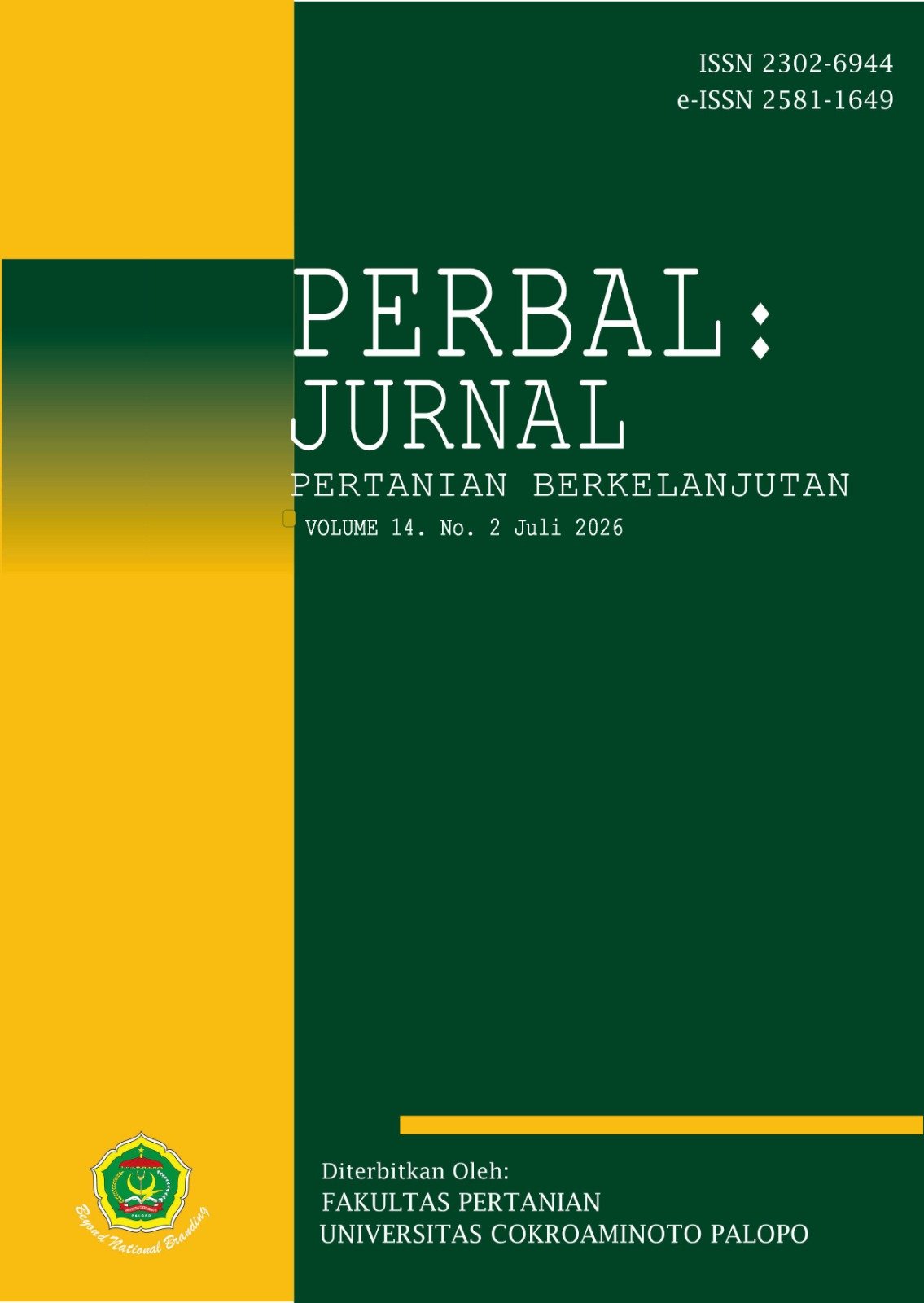
Analisis Pertumbuhan dan Kandungan Mineral Esensial (FE, CU, K) pada Microgreens Sawi Hijau (Brassica juncea L.) Terhadap Berbagai Jenis Media Tanam
Analysis of Growth and Essential Mineral Content (Fe, Cu, K) in Microgreens of Mustard Greens (Brassica juncea L.) in Various Types of Planting Media
DOI:
https://doi.org/10.30605/mwc9rf47Keywords:
Microgreens, media tanam, besi (Fe), tembaga (Cu), kalium (K)Abstract
Microgreens merupakan tanaman muda yang dibudidayakan secara singkat dan dikenal memiliki kandungan mineral, vitamin, dan senyawa fitokimia yang tinggi. Media tanam diketahui dapat memengaruhi kandungan mineral esensial pada microgreens karena berperan dalam menyediakan air dan unsur hara yang dibutuhkan tanaman. Penelitian bertujuan untuk mengetahui pengaruh berbagai jenis media tanam terhadap pertumbuhan dan kandungan mineral esensial (Fe, Cu, K) pada microgreens sawi hijau. Penelitian dilaksanakan pada bulan Desember 2025 sampai Januari 2026 di Gedung A Fakultas Pertanian Kampus 2 Universitas Singaperbangsa Karawang di Desa Margasari, Kecamatan Karawang Timur, Kabupaten Karawang, Jawa Barat. Metode penelitian yang digunakan adalah metode eksperimen dengan Rancangan Acak Kelompok (RAK) faktor tunggal yang terdiri atas 5 perlakuan dan 5 ulangan, sehingga diperoleh 25 unit percobaan. Perlakuan meliputi M0 = tanah, M1 = cocopeat, M2 = vermiculite, M3 = rockwool, dan M4 = perlite. Pengaruh perlakuan dianalisis menggunakan analisis ragam (ANOVA) dan dilanjutkan dengan uji Beda Nyata Terkecil (BNT) taraf 5%. Hasil penelitian menunjukkan bahwa berbagai jenis media tanam berpengaruh terhadap parameter laju pertumbuhan tinggi tanaman, laju pertumbuhan luas daun, dan kandungan mineral kalium, besi, dan tembaga. Media tanah (M0) memberikan hasil terbaik pada rata-rata laju pertumbuhan tinggi tanaman sebesar 0,450 cm/hari, laju pertumbuhan luas daun sebesar 0,090 cm2/hari, kandungan klorofil sebesar 37,1 unit, dan kandungan besi (Fe) sebesar 1.598,2 mg/ 100g.
Microgreens are young plants that are grown for a short period and are known to be rich in minerals, vitamins, and phytochemicals. Growing media are known to influence the essential mineral content of microgreens because they play a role in supplying the water and nutrients needed by the plants. This study aimed to determine the effect of various types of growing media on the growth and essential mineral content (Fe, Cu, K) of green mustard microgreens. The study was conducted from December 2025 to January 2026 in Building A of the Faculty of Agriculture, Campus 2, Singaperbangsa Karawang University, in Margasari Village, East Karawang District, Karawang Regency, West Java. The research method used was an experimental design with a single-factor randomized block design (RBD) consisting of 5 treatments and 5 replicates, resulting in 25 experimental units. The treatments included M0 = soil, M1 = cocopeat, M2 = vermiculite, M3 = rockwool, and M4 = perlite. The effects of the treatments were analyzed using analysis of variance (ANOVA) and followed by the Least Significant Difference (LSD) test at the 5% level. The results showed that various types of growing media affected the parameters of plant height growth rate, leaf area growth rate, and the mineral content of potassium, iron, and copper. Soil medium (M0) yielded the best results with an average plant height growth rate of 0.450 cm/day, a leaf area growth rate of 0.090 cm²/day, a chlorophyll content of 37.1 units, and an iron (Fe) content of 1,598.2 mg/100 g.
References
Ahmed, S., Sarker, S. K., Kamruzzaman, M., Perri, S., Hilmers, T., Uhl, E., Hossain, M. R., Tasnim, N., Naabeh, C. S. S., Anika, T. T., Rahman, M. M., dan Pretzsch, H. (2025). Soil nutrients and leaf area index interact with species and structural diversity to buffer mangrove productivity against salinity. Soil Ecology Letters, 7(2). https://doi.org/10.1007/s42832-025-0299-x
Ai, N. S., dan Banyo, Y. (2018). Konsentrasi klorofil daun sebagai indikator kekurangan air pada tanaman. Jurnal Ilmiah Sains, 15(1), 166. https://doi.org/10.35799/jis.11.2.2011.202
Alfy, M. N. T., dan Handoyo, T. (2022). Pengaruh dosis dan waktu aplikasi pupuk KCI terhadap pertumbuhan dan hasil tanaman buncis (Phaseolus vulgaris L.). Agriprima Journal of Applied Agricultural Sciences, 6(1), 85–97. https://doi.org/10.25047/agriprima.v6i1.431
Amir, A. Y. (2021). Hubungan kadar tembaga dalam asi dengan berat badan bayi 0-6 bulan di wilayah kerja Puskesmas Lubuk Buaya. Jurnal Kesehatan Saintika Meditory, 4(1), 9. https://doi.org/10.30633/jsm.v4i1.1019
Antonangelo, J. A., Culman, S., dan Zhang, H. (2024). Comparative analysis and prediction of cation exchange capacity via summation: influence of biochar type and nutrient ratios. Frontiers in Soil Science, 4(3), 1–14. https://doi.org/10.3389/fsoil.2024.1371777
Barańska, D., Panek, J., Różalska, S., Turnau, K., dan Frąc, M. (2025). Microgreens as the future of urban horticulture and superfoods, supported by post-harvest innovations for shelf-life increase: a review. Scientia Horticulturae, 350, 114303. https://doi.org/10.1016/j.scienta.2025.114303
Bhaswant, M., Shanmugam, D. K., Miyazawa, T., Abe, C., dan Miyazawa, T. (2023). Microgreens a comprehensive review of bioactive molecules and health benefits. Molecules, 28(2), 1–24. https://doi.org/10.3390/molecules28020867
Bhat, M. A., Mishra, A. K., Shah, S. N., Bhat, M. A., Jan, S., Rahman, S., Baek, K. H., dan Jan, A. T. (2024). Soil and mineral nutrients in plant health: a prospective study of iron and phosphorus in the growth and development of plants. Current Issues in Molecular Biology, 46(6), 5194–5222. https://doi.org/10.3390/cimb46060312
BPS. (2023). Statistik Indonesia 2023 Statistical Yearbook of Indonesia 2023. Badan Pusat Statistik, 1101001, 790. https://www.bps.go.id/publication/2020/04/29/e9011b3155d45d70823c141f/statistik-indonesia-2020.html
Ćirić, V., Prekop, N., Šeremešić, S., Vojnov, B., Pejić, B., Radovanović, D., dan Marinković, D. (2023). The implication of cation exchange capacity (CEC) assessment for soil quality management and improvement. Agriculture and Forestry, 69(4), 113–134. https://doi.org/10.17707/AgricultForest.69.4.08
Dias, G. C., Machado, R. M. A., Alves-Pereira, I., Ferreira, R. A., dan Gruda, N. S. (2025). Potential of pine bark to replace perlite in coir-based substrates: effects on nutrient uptake, growth, and phytochemicals in lettuce under two salinity levels. Plants, 14(16), 1–15. https://doi.org/10.3390/plants14162577
Dubey, S., Harbourne, N., Harty, M., Hurley, D., dan Elliott-Kingston, C. (2024). Microgreens production: Exploiting environmental and cultural factors for enhanced agronomical benefits. Plants, 13(18), 2631. https://doi.org/10.3390/plants13182631
Efendi, B., Supriyono, dan Dewi, W. S. (2020). Growth and Nitrogen uptake of kenikir (Cosmos Caudatus Kunth.) microgreens in a combination of manure and biochar planting media. IOP Conference Series: Earth and Environmental Science, 466(1), 012018. https://doi.org/10.1088/1755-1315/466/1/012018
Farmia. (2020). Pengaruh beberapa macam media tanam dan dosis serbuk cangkang telur ayam terhadap pertumbuhan microgreen brokoli (Brassica oleracea var. Italica Planck). Prosiding Seminar Nasional Pembangunan dan Pendidikan Vokasi Pertanian, 1(1), 30–39. https://doi.org/10.47687/snppvp.v1i1.123
Fathi, A. (2022). Role of nitrogen (N) in plant growth, photosynthesis pigments, and n use efficiency: a review. Agrisost 28(12), 1–8. https://doi.org/10.5281/zenodo.7438164
Fesendouz, S. O., Ebrahimzadeh, A., dan Rasouli, F. (2025). Using Agricultural Waste as an Alternative Growing Medium for Cultivating Cucumis Sativus L. Greenhouse Transplants. Scientific Reports, 15(1), 1–17. https://doi.org/10.1038/s41598-025-98564-1
Fitri, I., Arabia, T., dan Sufardi. (2019). Identifikasi fraksi Fe, Al, dan Si Amorf pada beberapa ordo tanah di lahan kering Aceh Besar dengan ekstraksi ammonium oksalat. Jurnal Ilmiah Mahasiswa Pertanian, 4(4), 618–628.
Food and Agriculture Organization of The United Nations (FAO) dan World Health Organization (WHO). (2001). Human Vitamin and Mineral Requirements: Report of a Joint FAO/WHO Expert Consultation, Bangkok, Thailand. FAO.
Gohardoust, M. R., Bar-Tal, A., Effati, M., dan Tuller, M. (2020). Characterization of physicochemical and hydraulic properties of organic and mineral soilless culture substrates and mixtures. Agronomy, 10(9). https://doi.org/10.3390/agronomy10091403
Handayani, S., Nasution, J., Friska, M., dan Wahyuni, S. H. (2025). Analisis kandungan unsur hara mikro pada tanah dan pengaruhnya terhadap kualitas kimia buah salak (Salacca sumatrana Becc.). Juster: Jurnal Sains dan Terapan, 4(3), 1–8. https://doi.org/10.57218/juster.v4i3.2198
Kalaivani, K., dan Jawaharlal, M. (2019). Study on physical characterization of coco peat with different proportions of organic amendments for soilless cultivation. Journal of Pharmacognosy and Phytochemistry, 8(3), 2283–2286.
Kane, S. F., Roberts, C., dan Paulus, R. (2021). Hereditary hemochromatosis: rapid evidence review. American Family Physician, 104(3), 263–270. https://www.aafp.org/pubs/afp/issues/2021/0900/p263.html
Kusumawati, A. (2021). Buku Ajar Kesuburan Tanah dan Pemupukan.
Kyriacou, M. C., El-nakhel, C., Pannico, A., Graziani, G., Soteriou, G. A., Giordano, M., Palladino, M., Ritieni, A., Pascale, S. De, dan Rouphael, Y. (2020). Phenolic constitution, phytochemical and macronutrient content in three species of microgreens as modulated by natural fiber and synthetic substrates. antioxidants, 9(3), 1–23.
Lahhob, Q. R., Al-sanaf, A. E., Mohammed, N. Y., Abbas, H. J., Ibrahim, Z. J., Najim, M. K., Malik, Z. A., Budaiwi, Z. K., Abdul-Jabbar, Z. H., dan Kadham, M. J. (2023). Mineral and trace elements, dietary sources, biological effects, deficiency, and toxicity: a review. Eurasian Chemical Communications, 5(6), 536–555. https://doi.org/10.22034/ecc.2023.381964.1594
Luis, Á., Pedroza-sandoval, A., Trejo-calzada, R., dan Garc, G. (2024). Pigments on Lotus Corniculatus L. in response to water deficit. Plants, 13(7).
Nishikawa, E., Almeida Neto, A. F., dan Vieira, M. G. A. (2014). Adsorption of copper in expanded vermiculite: kinetics and equilibrium. Congresso Brasileiro de Engenharia Química (COBEQ).
Novianto, N., Effendy, I., dan Aminurohman. (2020). Respon Pertumbuhan dan hasil tanaman sawi (Brassica juncea L.) terhadap pupuk organik cair hasil fermentasi sabut kelapa. Agroteknika, 3(1), 35–41. https://doi.org/10.32530/agroteknika.v3i1.67
Nur, F., dan Armita, D. (2023). Evaluation of soil fertility status in agricultural land of shallot in South Sulawesi. Jurnal Pertanian Agros, 25(3), 2310–2320.
Pant, Y., Lingwan, M., dan Masakapalli, S. K. (2023). Metabolic, biochemical, mineral and fatty acid profiles of edible brassicaceae microgreens establish them as promising functional food. Food Chemistry Advances, 3(9), 100461. https://doi.org/10.1016/j.focha.2023.100461
Rajaseger, G. (2023). Hydroponics: current trends in sustainable crop production. Bioinformation, 19(9), 925–938. https://doi.org/10.6026/97320630019925
Ratna, Suheri, H., dan Suryaningsih, L. (2020). Pertumbuhan dan hasil panen microgreen selada pada berbagai media tanam dan konsentrasi nutrisi. Jurnal Baiq, 1(1), 1–10.
Rizkiyah, N., dan Wijayanti, P. (2021). Microgreens sebagai alternatif budidaya tanaman pertanian urban. Prosiding Seminar Nasional Magister Agribisnis, 21–27.
Rohmanna, N. A., dan Mulyawan, R. (2022). The effect of growing media on the vitamin C and chlorophyll content of gelinggang microgreen. IOP Conference Series: Earth and Environmental Science, 1005(1). https://doi.org/10.1088/1755-1315/1005/1/012005
Safitri, I., Mertha, I. G., dan Raksun, A. (2025). Influence of NPK and bokashi on growth and chlorophyll content of pakcoy (Brassica rapa L.). Jurnal Biologi Tropis, 25(4), 5019–5029. https://doi.org/10.29303/jbt.v25i4.10393
Saepurohman, I. L., Rahayu, Y. S., Ranti, W., dan Mardiah, Z. (2025). Pertumbuhan dan hasil microgreens dua varietas selada keriting (Lactuca sativa L.) pada berbagai konsentrasi pupuk organik cair. Plantklopedia: Jurnal Sains dan Teknologi Pertanian, 5(1).
Sakina, I. V., Dewi, C. D. B., Andini, S. D., Rahmawati, M., dan Nurfadhila, L. (2022). Studi literatur : analisis kadar kalium pada makanan dan minuman. Journal of Pharmacy, Medical and Health Science, 3(9), 132–141. https://journal.unsika.ac.id/
Salvator, K., Willy, I., Soter, N., Christophe, N., dan Pierre, N. (2024). Predicting soil cation exchange capacity (CEC) from pH, percentage of clay and organic carbon: a case study on selected burundi surface soils. International Journal of Advances in Scientific Research and Engineering, 10(06), 01–09. https://doi.org/10.31695/ijasre.2024.6.1
Samtiya, M., Aluko, R. E., dan Dhewa, T. (2020). Plant food anti-nutritional factors and their reduction strategies: an overview. Food Production, Processing and Nutrition, 2(1), 1–14. https://doi.org/10.1186/s43014-020-0020-5
Sardans, J., dan Peñuelas, J. (2021). Potassium control of plant functions: ecological and agricultural implications. Plants, 10(2). https://doi.org/10.3390/plants10020419
Sari, R., Abdullah, A., dan Suriyanti, S. (2023). Pengaruh jenis media tanam dan formulasi hara terhadap pertumbuhan dan produksi tanaman sawi (Brassica rapa L.) yang ditanam secara hidroponik wick system. AGrotekMAS Jurnal Indonesia: Jurnal Ilmu Pertanian, 3(3), 52–61. https://doi.org/10.33096/agrotekmas.v3i3.277
Sasmita, E. R., dan Haryanto, D. (2021). Ragam media tanam: Tanah dan Non Tanah. Lppm UPN Veteran. Yogyakarta.
Schmitz, D., Girardi, J., Jamin, J., Bundschuh, M., Geng, B., Feldmann, R., Rösch, V., Riess, K., dan Schirmel, J. (2023). Copper uptake and its effects on two riparian plant species, the native Urtica dioica, and the invasive Fallopia japonica. Plants, 12(3), 481
Singh, A., Antil, E., Dalal, P., dan Bansal, M. (2025). Greening agriculture with cocopeat: paving the way for sustainable crop production. International Journal of Advanced Research, 13(02), 805–818. https://doi.org/10.21474/ijar01/20439
Suwarlan, S. A. (2020). Perancangan urban farming pada pesisir Kampung Kelembak Kepulauan Riau. Jurnal Linears, 3(1), 20–25. https://doi.org/10.26618/j-linears.v3i1.3134
Teo, G. (2021). Diagnosis dan tatalaksana kegawatdaruratan hiperkalemia. CDK: Continuing Medical Education, 48(8), 305–310.
Ulfah, I., dan Utami, T. K. (2025). Pengaruh dosis nitrogen terhadap pertumbuhan dan hasil tanaman kangkung darat (Ipomoea Reptans, Poir) varietas Bangkok Lp-1. Jurnal Greenation Pertanian dan Perkebunan, 2(2), 36–41. https://doi.org/10.38035/jgpp.v2i2.178
Wulaningsih, R. D., Purwanto, A., dan Anediandra, C. C. (2024). The effect of NPK pearl fertilizer on the germination of green mustard seeds (Brassica juncea L.) (Issue Smic). Atlantis Press International. https://doi.org/10.2991/978-94-6463-624-6_5
Xiao, Z., Codling, E. E., Luo, Y., Nou, X., Lester, G. E., dan Wang, Q. (2016). Microgreens of brassicaceae: mineral composition and content of 30 varieties. Journal of Food Composition and Analysis, 49, 87–93. https://doi.org/10.1016/j.jfca.2016.04.006
Yolanda, W., Fatchullah, D., Purbajanti, E. D., dan Sumarsono, D. (2020). Pertumbuhan dan produksi selada merah (Lettuce Lolorosa) akibat kombinasi pupuk kotoran kambing dan FeSO4. Jurnal Agro Complex, 4(2), 125–131.
Zhang, Y., Xiao, Z., Ager, E., Kong, L., dan Tan, L. (2021). Nutritional quality and health benefits of microgreens, a crop of modern agriculture. Journal of Future Foods, 1(1), 58–66.
Downloads
Published
Issue
Section
License
Copyright (c) 2026 Karina Dwi Agustina, Yayu Sri Rahayu, Winda Rianti

This work is licensed under a Creative Commons Attribution 4.0 International License.
In submitting the manuscript to the journal, the authors certify that:
- They are authorized by their co-authors to enter into these arrangements.
- The work described has not been formally published before, except in the form of an abstract or as part of a published lecture, review, thesis, or overlay journal.
- That it is not under consideration for publication elsewhere,
- That its publication has been approved by all the author(s) and by the responsible authorities – tacitly or explicitly – of the institutes where the work has been carried out.
- They secure the right to reproduce any material that has already been published or copyrighted elsewhere.
- They agree to the following license and copyright agreement.
License and Copyright Agreement
Authors who publish with Onoma Journal: Education, Languages??, and Literature agree to the following terms:
- Authors retain copyright and grant the journal right of first publication with the work simultaneously licensed under Creative Commons Attribution License (CC BY 4.0) that allows others to share the work with an acknowledgment of the work's authorship and initial publication in this journal.
- Authors are able to enter into separate, additional contractual arrangements for the non-exclusive distribution of the journal's published version of the work (e.g., post it to an institutional repository or publish it in a book), with an acknowledgment of its initial publication in this journal.
- Authors are permitted and encouraged to post their work online (e.g., in institutional repositories or on their website) prior to and during the submission process, as it can lead to productive exchanges, as well as earlier and greater citation of published work.