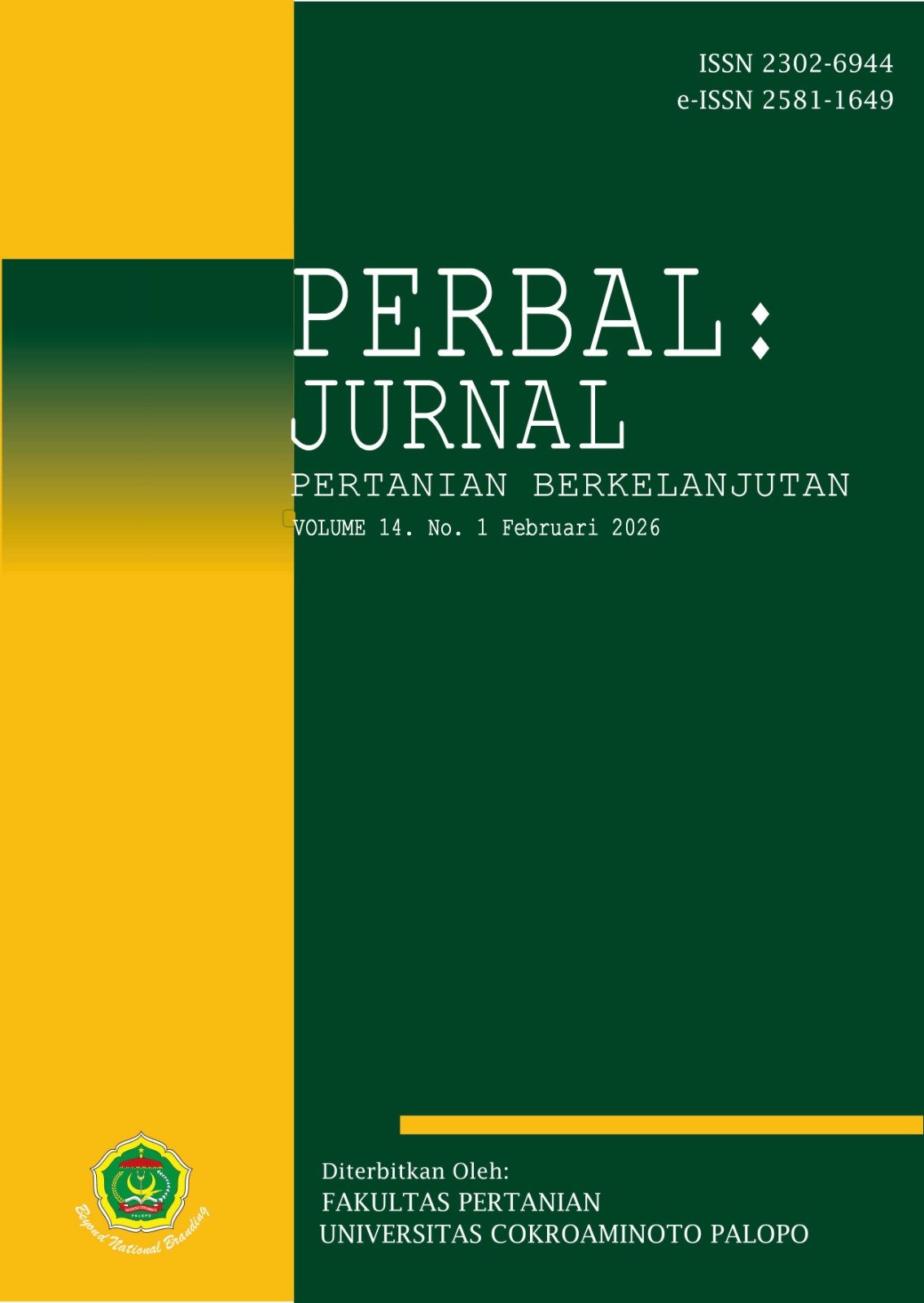
Produktivitas Tanaman Labu Kuning Varietas Hibrida Kuning dan Zucchini yang Diberikan Kombinasi Pemupukan Pupuk Organik Hayati dan Pupuk Anorganik
Productivity of Yellow Pumpkin Hybrid and Zucchini Varieties Under Combined Application of Solid Bio-Organic Fertilizer and Inorganic Fertilizer
DOI:
https://doi.org/10.30605/perbal.v14i1.8143Keywords:
Bio Soltamax, Efisiensi Pupuk Kimia, Pertanian BerkelanjutanAbstract
Labu kuning (Cucurbita moschata) dan zucchini (Cucurbita pepo) merupakan komoditas hortikultura yang memiliki nilai ekonomi tinggi. Produktivitas tanaman labu sangat dipengaruhi oleh ketersediaan hara yang optimal dan berkelanjutan. Kombinasi pupuk organik hayati dan pupuk anorganik berpotensi meningkatkan efisiensi pemupukan sekaligus memperbaiki kesuburan tanah. Penelitian ini bertujuan untuk menganalisis pengaruh kombinasi pupuk organik hayati padat Bio Soltamax dan pupuk anorganik terhadap produktivitas labu kuning varietas hibrida dan zucchini. Penelitian menggunakan metode eksperimental dengan analisis komparatif dengan perlakuan kelompok kontrol, yaitu pemupukan kimia tunggal 100% (Urea, SP-36, dan KCl) dan kelompok perlakuan kombinasi, yaitu pupuk organik padat Bio Soltamax dengan pengurangan pupuk anorganik hingga 50%. Pengamatan dilakukan terhadap bobot hasil tanaman. Hasil penelitian menunjukkan pemberian kombinasi pupuk organik padat Bio Soltamax dengan pupuk anorganik mampu meningkatkan produktivitas labu kuning hibrida dan zucchini dibandingkan dengan 100% pupuk anorganik. Peningkatan bobot buah menunjukkan peran konsorsium mikroba dalam meningkatkan efisiensi serapan hara serta mendukung pertumbuhan dan pengisian buah. Kandungan bahan organik yang tinggi dalam pupuk organik padat mampu memperbaiki sifat fisik dan biologis tanah sehingga meningkatkan ketersediaan dan serapan hara. Integrasi antara pupuk organik hayati padat Bio Soltamax dan pupuk anorganik mampu meningkatkan hasil tanaman sekaligus mengefisienkan penggunaan pupuk kimia, sehingga berpotensi menjadi strategi pemupukan yang efektif dan berkelanjutan pada budidaya labu kuning.
Yellow pumpkin (Cucurbita moschata) and zucchini (Cucurbita pepo) are horticultural commodities with high economic value. Pumpkin productivity is strongly influenced by optimal and sustainable nutrient availability. The combination of bio-organic and inorganic fertilizers has the potential to improve fertilization efficiency while enhancing soil fertility. This study aimed to analyze the effect of combining solid bio-organic fertilizer Bio Soltamax and inorganic fertilizers on the productivity of hybrid yellow pumpkin and zucchini. The research employed an experimental method with comparative analysis using a control treatment consisting of 100% chemical fertilization (Urea, SP-36, and KCl) and a combination treatment of solid bio-organic fertilizer Bio Soltamax with a reduction of inorganic fertilizer by up to 50%. Observations were focused on yield weight. The results showed that the application of solid bio-organic Bio Soltamax combined with inorganic fertilizers increased the productivity of hybrid yellow pumpkin and zucchini compared with 100% inorganic fertilization. The increase in fruit weight indicates the role of microbial consortia in improving nutrient uptake efficiency and supporting plant growth and fruit filling. The high organic matter content in the solid bio-organic fertilizer improved the physical and biological properties of the soil, thereby enhancing nutrient availability and uptake. The integration of solid bio-organic fertilizer Bio Soltamax with inorganic fertilizers increased crop yield while improving the efficiency of chemical fertilizer use, indicating its potential as an effective and sustainable fertilization strategy for pumpkin cultivation.
References
Adesemoye, A. O., & Kloepper, J. W. (2009). Plant–microbes interactions in enhanced fertilizer-use efficiency. Applied Microbiology and Biotechnology, 85(1), 1–12. DOI: https://doi.org/10.1007/s00253-009-2196-0
Agegnehu, G., Nelson, P. N., & Bird, M. I. (2017). The effects of biochar, compost and their mixture and nitrogen fertilizer on yield and nitrogen use efficiency of barley. Science of the Total Environment, 569–570, 869–879. DOI: https://doi.org/10.1016/j.scitotenv.2016.05.033
Amalia, I. S., Giffari, F. R., Mastur, A. I., & Rohimat, N. (2025). Penggunaan pupuk hayati padat organik terhadap pertumbuhan dan bobot hasil panen tanaman kembang kol. Biogenerasi: Jurnal Pendidikan Biologi, 10(2), 959–967. DOI: https://doi.org/10.30605/biogenerasi.v10i2.5397
Darrudi, R., Nazeri, V., Soltani, F., & Shokrpour, M. (2018). Genetic diversity of Cucurbita pepo L. and Cucurbita moschata Duchesne accessions using fruit and seed quantitative traits. Journal of Applied Research on Medicinal and Aromatic Plants, 9, 29–36. DOI: https://doi.org/10.1016/j.jarmap.2018.02.006
Giffari, F. R., Amalia, I. S., Mulyani, S., Mastur, A. I., & Rohimat, N. (2025). Respons bobot panen jagung manis (Zea mays L. var. saccharata) yang diberikan pupuk daun organik mikro partikel dengan kombinasi pupuk anorganik. Bio Sains: Jurnal Ilmiah Biologi, 5(2), 1–10.
Glick B. R. (2012). Plant growth-promoting bacteria: mechanisms and applications. Scientifica, 2012,963401. https://doi.org/10.6064/2012/963401 DOI: https://doi.org/10.6064/2012/963401
Guo, J. H., Liu, X. J., Zhang, Y., Shen, J. L., Han, W. X., Zhang, W. F., … Zhang, F. S. (2010). Significant acidification in major Chinese croplands. Science, 327(5968), 1008–1010. DOI: https://doi.org/10.1126/science.1182570
Gupta, G., Parihar, S. S., Ahirwar, N. K., Snehi, S. K., & Singh, V. (2015). Plant growth promoting rhizobacteria (PGPR): current and future prospects for development of sustainable agriculture. Journal of Microbial & Biochemical Technology, 7(2), 96–102.
Hungria, M., Campo, R. J., Souza, E. M., & Pedrosa, F. O. (2010). Inoculation with selected strains of Azospirillum brasilense and A. lipoferum improves yields of maize and wheat in Brazil. Plant and Soil, 331, 413–425. DOI: https://doi.org/10.1007/s11104-009-0262-0
Lal, R. (2015). Restoring soil quality to mitigate soil degradation. Sustainability, 7(5), 5875–5895. DOI: https://doi.org/10.3390/su7055875
Montero-Paez, A., Esteras, C., Martínez-Pérez, E., Gómez, P., & Picó, B. (2022). Fruit shape diversity in Cucurbita pepo is associated with differential biomass allocation. Scientia Horticulturae, 295, 110850.
Paris, H. S. (2016). Origin and diversification of Cucurbita pepo. Horticultural Reviews, 44, 1–54.
Prasad, S., Gupta, S. C., Tyagi, A. K., & Aggarwal, B. B. (2014). Curcumin, a component of turmeric (Curcuma longa), from farm to pharmacy. Biotechnology Advances, 32(6), 1053–1064. DOI: https://doi.org/10.1016/j.biotechadv.2014.04.004
Pretty, J. (2018). Intensification for redesigned and sustainable agricultural systems. Science, 362(6417), eaav0294. DOI: https://doi.org/10.1126/science.aav0294
Richardson, A. E., Barea, J. M., McNeill, A. M., & Prigent-Combaret, C. (2009). Acquisition of phosphorus and nitrogen in the rhizosphere and plant growth promotion by microorganisms. Plant and Soil, 321, 305–339. DOI: https://doi.org/10.1007/s11104-009-9895-2
Simanungkalit, R. D. M., Suriadikarta, D. A., Saraswati, R., Setyorini, D., & Hartatik, W. (2006). Pupuk Organik dan Pupuk Hayati. Balai Besar Penelitian dan Pengembangan Sumberdaya Lahan Pertanian. Bogor.
Vessey, J. K. (2003). Plant growth promoting rhizobacteria as biofertilizers. Plant and Soil, 255, 571–586. DOI: https://doi.org/10.1023/A:1026037216893
Zebua, T., Lase, N. K., & Telaumbanua, P. H. (2025). Pengaruh mikroorganisme terhadap ketersediaan nutrisi pada tanaman jagung: Kajian literatur. Jurnal Ilmu Pertanian dan Teknologi dalam Ilmu Tanaman, 2(1), 115–123. DOI: https://doi.org/10.62951/hidroponik.v2i1.232
Zufahmi, Z., Suranto, S., & Mahajoeno, E. (2018). Karakteristik tanaman labu kuning (Cucurbita moschata) berdasarkan penanda morfologi dan pola pita isozim peroksidase. Prosiding Seminar Nasional Biotik, 3(1).
Downloads
Published
Issue
Section
License
Copyright (c) 2026 Istia Siti Amalia, Fahri Rijal Giffari, Reza Septianugraha, Tsalisah Halimatussadiah, Adhi Irianto Mastur, Nanang Rohimat

This work is licensed under a Creative Commons Attribution 4.0 International License.
In submitting the manuscript to the journal, the authors certify that:
- They are authorized by their co-authors to enter into these arrangements.
- The work described has not been formally published before, except in the form of an abstract or as part of a published lecture, review, thesis, or overlay journal.
- That it is not under consideration for publication elsewhere,
- That its publication has been approved by all the author(s) and by the responsible authorities – tacitly or explicitly – of the institutes where the work has been carried out.
- They secure the right to reproduce any material that has already been published or copyrighted elsewhere.
- They agree to the following license and copyright agreement.
License and Copyright Agreement
Authors who publish with Onoma Journal: Education, Languages??, and Literature agree to the following terms:
- Authors retain copyright and grant the journal right of first publication with the work simultaneously licensed under Creative Commons Attribution License (CC BY 4.0) that allows others to share the work with an acknowledgment of the work's authorship and initial publication in this journal.
- Authors are able to enter into separate, additional contractual arrangements for the non-exclusive distribution of the journal's published version of the work (e.g., post it to an institutional repository or publish it in a book), with an acknowledgment of its initial publication in this journal.
- Authors are permitted and encouraged to post their work online (e.g., in institutional repositories or on their website) prior to and during the submission process, as it can lead to productive exchanges, as well as earlier and greater citation of published work.