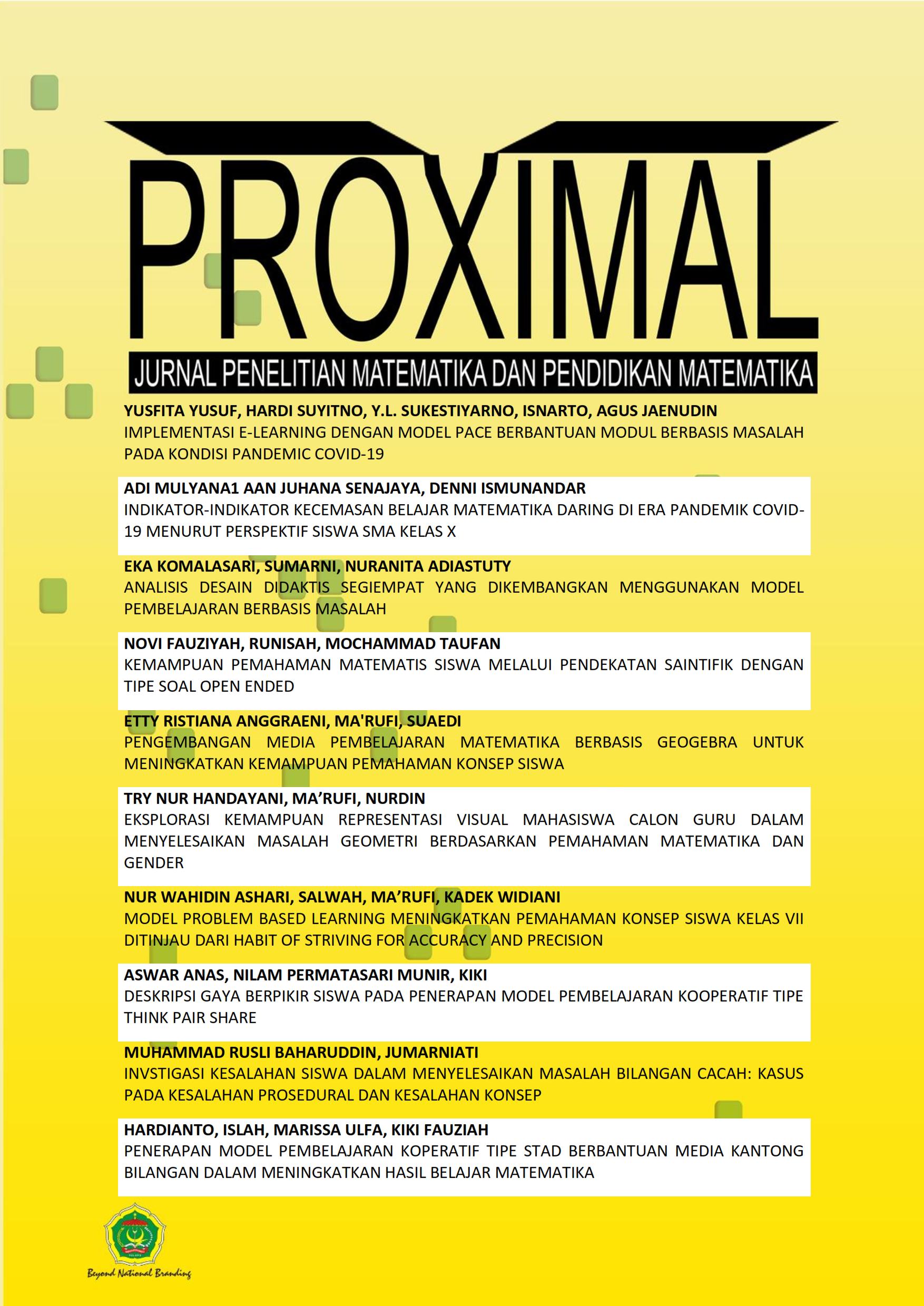
KEMAMPUAN PEMAHAMAN MATEMATIS SISWA MELALUI PENDEKATAN SAINTIFIK DENGAN TIPE SOAL OPEN ENDED
DOI:
https://doi.org/10.30605/proximal.v4i1.478Keywords:
open ended, pemahaman matematis, pendekatan saintifikAbstract
ABSTRAK
Tujuan penelitian ini untuk mengkaji kemampuan pemahaman matematis siswa melalui penggunaan pendekatan saintifik dengan soal open ended dan pendekatan saintifik tanpa soal open ended. Selain itu, penelitian ini bertujuan untuk mengetahuai pengaruh pemberian soal open ended pada pendekatan Saintifik terhadap kemampuan pemahaman matematis siswa. Penelitian menggunakan metode kuasi eksperimen dengan populasi terdiri dari siswa kelas VIII di salah satu sekolah di Kabupaten Indramayu, Jawa Barat. Sampel diambil dua kelas dengan menggunakan teknik simple random sampling. Satu kelas belajar melalui pendekatan saintifik dengan pemberian soal open ended, sedangkan kelas lain menggunakan pendekatan Saintifik tanpa pemberian soal open ended. Berdasarkan hasil penelitian, kemampuan pemahaman matematis siswa melalui penggunaan pendekatan saintifik dengan soal open ended dan pendekatan saintifik tanpa soal open ended masih rendah. Tidak terdapat pengaruh pemberian soal open ended pada pendekatan saintifik terhadap kemampuan pemahaman matematis siswa.
Kata Kunci : open ended, pemahaman matematis, pendekatan saintifik.
ABSTRACT
The purpose of this study is to examine students' mathematical understanding ability through the use of scientific approaches with open ended problems and scientific approaches without open ended problems. In addition, this study aims to explore the influence of open ended problems on scientific approaches to students' mathematical understanding ability The study used quasi-experimental methods with a population consisting of grade VIII students in one of the schools in Indramayu Regency, West Java. Samples were taken in two classes using simple random sampling techniques. One class learned through a scientific approach by giving open ended problems, while the other class used a Scientific approach without giving open ended problems. Based on the results of the study, students' mathematical understanding ability through the use of scientific approaches with open ended problems and scientific approaches without open ended problems are still low. There is no effect of giving open ended problems on scientific approaches to students' mathematical understanding ability
References
Downloads
Published
Issue
Section
License
In submitting the manuscript to the journal, the authors certify that:
- They are authorized by their co-authors to enter into these arrangements.
- The work described has not been formally published before, except in the form of an abstract or as part of a published lecture, review, thesis, or overlay journal.
- That it is not under consideration for publication elsewhere,
- That its publication has been approved by all the author(s) and by the responsible authorities – tacitly or explicitly – of the institutes where the work has been carried out.
- They secure the right to reproduce any material that has already been published or copyrighted elsewhere.
- They agree to the following license and copyright agreement.
License and Copyright Agreement
Authors who publish with this journal agree to the following terms:
- Authors retain copyright and grant the journal right of first publication with the work simultaneously licensed under Creative Commons Attribution License (CC BY 4.0) that allows others to share the work with an acknowledgment of the work's authorship and initial publication in this journal.
- Authors are able to enter into separate, additional contractual arrangements for the non-exclusive distribution of the journal's published version of the work (e.g., post it to an institutional repository or publish it in a book), with an acknowledgment of its initial publication in this journal.
- Authors are permitted and encouraged to post their work online (e.g., in institutional repositories or on their website) prior to and during the submission process, as it can lead to productive exchanges, as well as earlier and greater citation of published work.