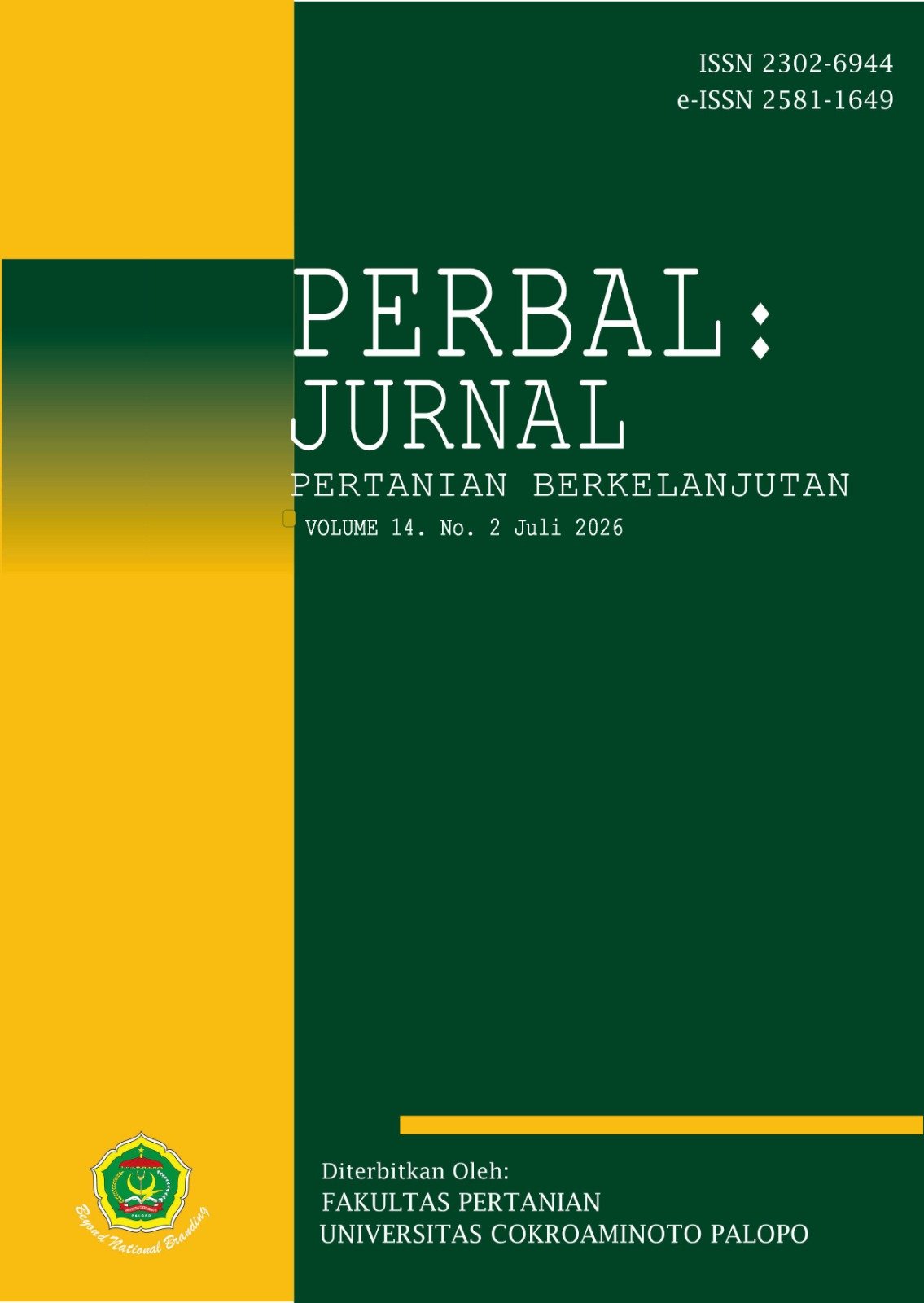
Respon Pertumbuhan dan Kemampuan Serapan Nikel Tanaman Jagung (Zea mays L.) dan Kedelai (Glycine max (L.) Merr.) yang Ditanam pada Lahan Sekitar Area Tambang
Growth Response and Nickel Absorption Ability of Corn (Zea mays L.) and Soybeans (Glycine max (L.) Merr.) Planted on Land Around the Mining Area
DOI:
https://doi.org/10.30605/90b0zv17Keywords:
adaptasi, jagung, kedelai, logam berat, remediasiAbstract
Penambangan nikel seringkali meninggalkan lahan terdegradasi dengan kandungan logam berat, termasuk nikel (Ni), yang dapat bersifat toksik bagi tanaman. Penelitian ini dilakukan dalam bentuk percobaan di Nursery PT.Vale selama enam bulan (Desember 2023 sampai Mei 2024) Tujuan penelitian untuk menganalisis respon pertumbuhan serta kemampuan serapan nikel pada tanaman jagung dan kedelai yang dibudidayakan di lahan sekitar area tambang nikel. Parameter yang diamati meliputi tinggi tanaman, jumlah daun, berat kering biomassa, produksi serta kadar nikel dalam jaringan tanaman menggunakan spektrofotometri serapan atom (AAS). Hasil penelitian menunjukkan bahwa tanaman jagung yang tumbuh pada media tanam dengan Ni rendah menghasilkan biomassa (bobot kering) dan produksi (biji) yang lebih banyak dibandingkan dengan yang ditanam pada media Ni tinggi, namun hasilnya masih sangat rendah dibandingkan pada kondisi media tanam Ni normal. Biji kedelai yang tumbuh pada media tanam dengan Ni tinggi mengandung logam Ni dalam jumlah lebih banyak yaitu 0.106 tan-1 melebihi nilai ambang batas logam Ni pada tanaman (Standar WHO) yaitu 10 µg g-1 berat kering sehingga tidak aman untuk dikonsumsi, sedang yang paling rendah adalah jagung yaitu 0.023 g kg-1. Disimpulkan bahwa tanaman jagung dan kedelai tidak sesuai untuk dikembangkan di lahan pasca tambang karena produksi yang rendah.
Nickel mining often leaves degraded land with heavy metal content, including nickel (Ni), which can be toxic to plants. This research was conducted in the form of an experiment at PT. Vale Nursery for six months (December 2023 to May 2024). The purpose of the study was to analyze the growth response and nickel absorption capacity of corn and soybean plants cultivated in the land around the nickel mining area. The parameters observed included plant height, number of leaves, dry weight of biomass, production and nickel levels in plant tissue using atomic absorption spectrophotometry (AAS). The results showed that corn plants grown in low Ni growing media produced more biomass (dry weight) and production (seeds) compared to those grown in high Ni media, but the results were still very low compared to normal Ni growing media conditions. Soybean seeds grown in high Ni growing media contained more Ni metal, namely 0.106 tan-1 exceeding the threshold value of Ni metal in plants (WHO Standard) which is 10 µg g-1 dry weight so it is not safe for consumption, while the lowest was corn, namely 0.023 g kg-1. It was concluded that corn and soybean plants were not suitable for development on post-mining land due to low production.
References
Bani, A., G. Echevarria, S. Sulce & J.L.Morel. (2008). Development Of A Technology For Extensive Phytoextraction Of Nickel On An Ultramafic Site (Albania). In V. Bert (Ed.),
Bhat, B. A., Rather, M. A., Bilal, T., Nazir, R., Qadir, R. U., & Mir, R. A. (2025). Plant hyperaccumulators: a state-of-the-art review on mechanism of heavy metal transport and sequestration. Frontiers in Plant Science, 16 DOI: https://doi.org/10.3389/fpls.2025.1631378
Corseuil, H.X and F.N. Moreno. (2001). Phytoremediation potential of willow trees for aquiferscontaminated with ethanol-blended gasoline. Water Research. 35(12), 3013-3017. DOI: https://doi.org/10.1016/S0043-1354(00)00588-1
Darusman, Syakur, Zaitun & Jufri, Y. (2021). Serapan hara N, P, dan K akibat pemberian beberapa jenis biochar pada tanah bekas galian tambang. Jurnal IPA & Pembelajaran IPA. 5(1), 90-100. DOI: https://doi.org/10.24815/jipi.v5i1.19968
Domec, J.-C., Noormets A., King J.S., Sun G., McNulty S.G.,Gavazzi M.J., Boggs J.L. & Treasure E.A. (2009). Decoupling the influence of leaf and root hydraulic conductances on stomatal conductance and its sensitivity to vapour pressure deficit as soil dries in a drained lablolly pine plantation. Plant, Cell and Environment, 32, 980 – 981. DOI: https://doi.org/10.1111/j.1365-3040.2009.01981.x
Engwa, G.A., Ferdinand, P.U., Nwalo, F.N., & Unachukwu, M.N. (2019). Mechanism and health effects of heavy metal toxicity in humans. DOI: http://dx.doi.org/10.5772/intechopen.82511. DOI: https://doi.org/10.5772/intechopen.82511
Freitas, S., Rodak, W., Reis, R.D., Reis, D.B., Carvalho, S.D., Schulze, Carneiro, C., & Guilherme, G. (2018). Hidden nickel deficiency? nickel fertilization via soil improves nitrogen metabolism and grain yield in soybean genotypes. Frontiers Plant Science, 8(9), 614. doi: 10.3389/fpls.2018.00614. DOI: https://doi.org/10.3389/fpls.2018.00614
Haruna, N., Wardiyati, T. & Maghfoer, M. D. (2020). The use of citric acid and NPK fertilizer to enhance phytoextraction of nickel by Bajo starfruit plant (Sarcotheca celebica Veldk.). Journal of Degraded and Mining Lands Management. 7(3), 2123-2132 DOI: https://doi.org/10.15243/jdmlm.2020.073.2123
Hidayati, N. (2005). Fitoremediation and potency of hyperaccumulator plants. Hayati Journal of Biosciences. 12(1), 35-40 DOI: https://doi.org/10.1016/S1978-3019(16)30321-7
Kabata-Pendias, A., & Pendias, H. (2001). Trace Elements in Soil and Plants. (3rd Edition). CRC Press. Boca Raton, Florida. 413 pp DOI: https://doi.org/10.1201/9781420039900
Morkunas, I., Woz´niak, A., Mai, V. C., Rucin´ska-Sobkowiak, R. & Jeandet, P. (2018). The role of heavy metals in plant response to biotic stress. Molecules. 23,(2320), 1-30. DOI: https://doi.org/10.3390/molecules23092320
Naisila, Kholimah, S. P. N., Chairunnisa, V. O. & Viratama, I. P. (2023). Tumbuhan. Bioedutech: Jurnal Biologi, Pendidikan Biologi, dan Teknologi Kesehatan. 2(2), 193-203
Netty S., Wardiyati, T., Handayanto, E., & Maghfoer, M. D. (2012). Nickel accumulating plants in the post-mining land of Sorowako, South Sulawesi, Indonesia. Journal of Tropical Agriculture. 50(1-2), 45-48.
Oktavian, P., Anas, M., Kasman, Sudiana, I. N., Safaani, J. & Agusu, L. (2024). Studi Kajian literatur: pengaruh keberadaan logam berat terhadap tingkat kesuburan tanah di Indonesia. Einstein's: Research Journal of Applied Physics. 2(1), 20-23. DOI: https://doi.org/10.33772/einsteins.v2i1.645
Patel, B., Sharma, Y. M., Tagore, G. S., Sharma, G. D., & Halecha, G. (2019). Heavy metal accrual in soils and crops grown in the peri urban areas of Jabalpur district of Madhya Pradesh, India using geospatial techniques. International Journal of Current Microbiology and Applied Sciences. 8(2), 64-90. DOI: https://doi.org/10.20546/ijcmas.2019.802.010
Santosa, H. R., Suherman, C. & Rosniawaty, S. (2016). Respons pertumbuhan tanaman kopi robusta (Coffea robusta L.) tercekam aluminium di lahan reklamasi bekas tambang batubara bervegetasi sengon (Periode El Nino). Jurnal Agrikultura, 27(3), 124-131 DOI: https://doi.org/10.24198/agrikultura.v27i3.10871
Setyowati, R. D. N., Amala, N. A., & Aini, N. N. U. (2018). Studi pemilihan tanaman revegetasi untuk keberhasilan reklamasi lahan bekas tambang. Al-Ard Jurnal Teknik Lingkungan. 3(1), 14-20. DOI: https://doi.org/10.29080/alard.v3i1.256
Shah, F.U.R, Ahmad, N., Masood, K.R., Peralta-Videa, J.R., & Ahmad, F.D. 2010. Plant Adaptation and Phytoremediation. Chapter 4 Heavy Metal Toxicity in Plants. 71-97 pp. DOI: https://doi.org/10.1007/978-90-481-9370-7_4
Suharjo, M. H., Ernawati, R. & Nurkhamim. (2022). Cekaman logam berat cromium terhadap tanaman. Jurnal Teknologi Mineral FT UNMUL. 10(1), 8-16. DOI: https://doi.org/10.30872/jtm.v10i1.7496
Tuherkih, E. & Sipahutar, I.A. (2010). Pengaruh pupuk NPK majemuk (16:16:15) terhadap pertumbuhan dan hasil jagung (Zea mays L) di tanah inceptisol. Prosiding Seminar Nasional Sumberdaya Lahan Pertanian. Buku II: Konservasi Lahan, Pemupukan, dan Biologi Tanah, Bogor.
Downloads
Published
Issue
Section
License
Copyright (c) 2026 Naima Haruna, Rosnina Rosnina, Rahmi Azizah Mudaffar, Ratna Rahim, Sitti Maryam Yasin

This work is licensed under a Creative Commons Attribution 4.0 International License.
In submitting the manuscript to the journal, the authors certify that:
- They are authorized by their co-authors to enter into these arrangements.
- The work described has not been formally published before, except in the form of an abstract or as part of a published lecture, review, thesis, or overlay journal.
- That it is not under consideration for publication elsewhere,
- That its publication has been approved by all the author(s) and by the responsible authorities – tacitly or explicitly – of the institutes where the work has been carried out.
- They secure the right to reproduce any material that has already been published or copyrighted elsewhere.
- They agree to the following license and copyright agreement.
License and Copyright Agreement
Authors who publish with Onoma Journal: Education, Languages??, and Literature agree to the following terms:
- Authors retain copyright and grant the journal right of first publication with the work simultaneously licensed under Creative Commons Attribution License (CC BY 4.0) that allows others to share the work with an acknowledgment of the work's authorship and initial publication in this journal.
- Authors are able to enter into separate, additional contractual arrangements for the non-exclusive distribution of the journal's published version of the work (e.g., post it to an institutional repository or publish it in a book), with an acknowledgment of its initial publication in this journal.
- Authors are permitted and encouraged to post their work online (e.g., in institutional repositories or on their website) prior to and during the submission process, as it can lead to productive exchanges, as well as earlier and greater citation of published work.