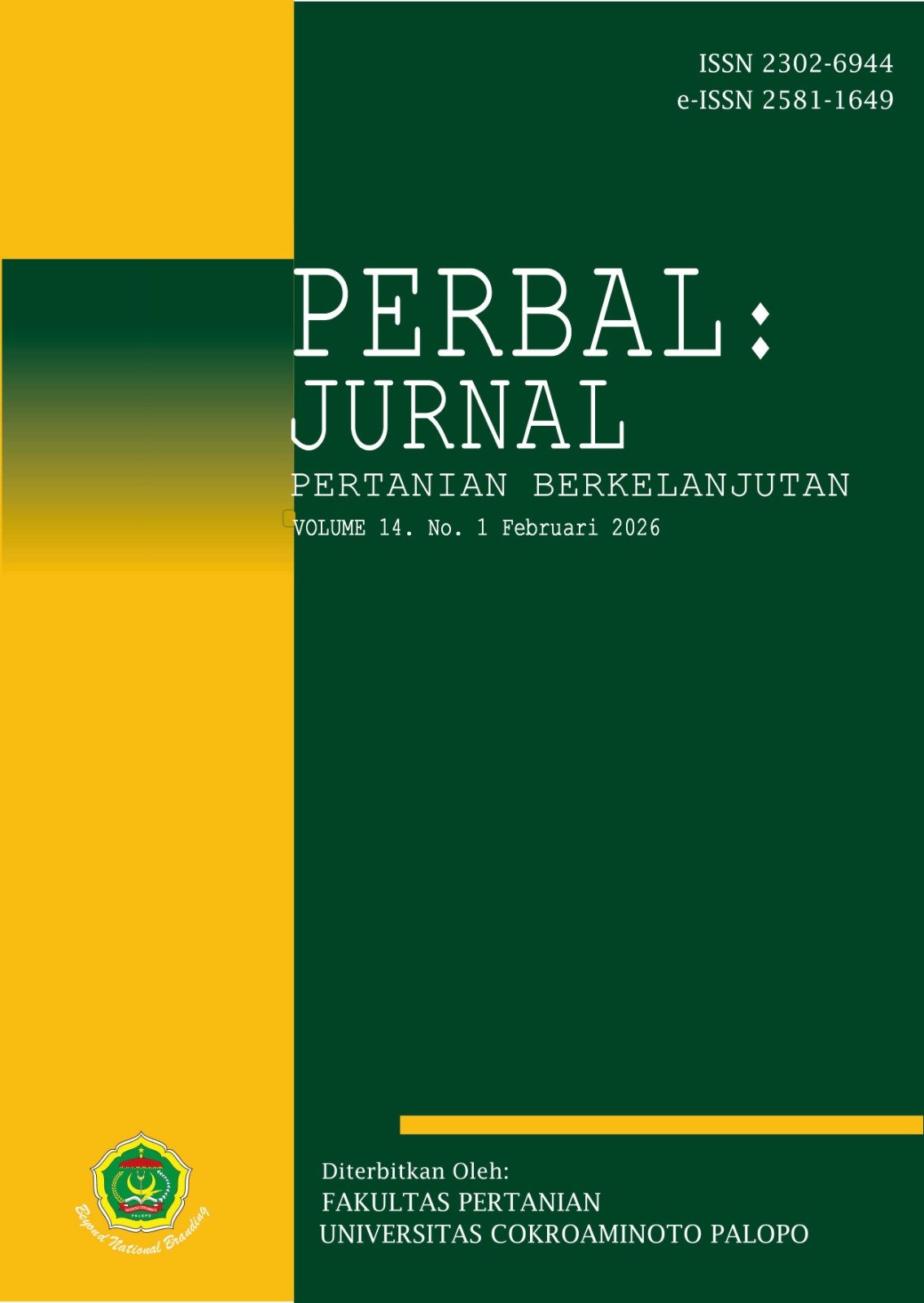
Kajian Ketahanan Terinduksi Cabai Rawit Terhadap Jamur Colletotrichum gloeosporioides Menggunakan Kitosan
Study of Induced Resistance in Chili Pepper Against Colletotrichum gloeosporioides Using Chitosan
DOI:
https://doi.org/10.30605/perbal.v14i1.7913Keywords:
antraknosa, Capsicum frutescens, Colletotrichum gloeosporioides, kitosan, ketahanan terinduksiAbstract
Penyakit antraknosa yang disebabkan oleh jamur Colletotrichum gloeosporioides merupakan kendala utama dalam budidaya cabai rawit. Penelitian ini bertujuan untuk mengkaji potensi kitosan sebagai agen penginduksi ketahanan tanaman (ISR) dan biostimulan, serta membandingkan efektivitasnya dengan fungisida dalam mengendalikan penyakit antraknosa berdasarkan waktu aplikasi yang berbeda. Penelitian ini menggunakan Rancangan Acak Kelompok (RAK) dengan delapan perlakuan dan tiga ulangan. Perlakuan terdiri dari Kontrol Negatif (P0-: tanpa inokulasi/pengendalian), Kontrol Positif (P0+: inokulasi penyakit), tiga variasi waktu aplikasi fungisida (P1, P2, P3), dan tiga variasi waktu aplikasi kitosan (P4, P5, P6). Waktu aplikasi yang diuji adalah dua minggu sebelum inokulasi, bersamaan inokulasi, dan dua minggu setelah inokulasi. Parameter yang diamati meliputi intensitas serangan antraknosa pada daun dan buah, efektivitas pengendalian, serta parameter pertumbuhan tanaman (jumlah akar, panjang akar, berat basah dan kering akar serta berat basah dan kering tajuk). Hasil penelitian menunjukkan bahwa penggunaan kitosan efektif dan setara dengan fungisida dalam menekan intensitas serangan antraknosa. Perlakuan aplikasi kitosan dua minggu sebelum inokulasi (P4) memberikan hasil yang paling optimal, yaitu intensitas serangan pada buah yang paling rendah (38,6%) dan efektivitas pengendalian yang paling tinggi (19,99%). Hal ini mengindikasikan bahwa aplikasi kitosan di awal berperan kuat dalam menginduksi sistem pertahanan tanaman sebelum patogen menyerang. Selain itu, kitosan juga berfungsi sebagai biostimulan yang signifikan meningkatkan pertumbuhan vegetatif, ditunjukkan oleh peningkatan berat basah/kering serta perkembangan akar dan tajuk.
Anthracnose disease, caused by the fungus Colletotrichum gloeosporioides, is a major constraint in chili pepper (Capsicum frutescens) cultivation. This research aimed to investigate the potential of chitosan as an agent for inducing plant resistance (ISR) and as a biostimulant, while comparing its effectiveness with fungicides in controlling anthracnose based on different application timings. The study employed a Randomized Block Design (RBD) with eight treatments and three replications. Treatments included Negative Control (P0-: no inoculation/no control), Positive Control (P0+: disease inoculation), three variations of fungicide application timing (P1, P2, P3), and three variations of chitosan application timing (P4, P5, P6). The application timings tested were two weeks before inoculation, simultaneous with inoculation, and two weeks after inoculation. Observed parameters included the incidence and severity of leaf and fruit anthracnose, control effectiveness, and plant growth parameters (number of roots, length of roots, fresh and dry root weight, and fresh and dry shoot weight,). The results showed that the use of chitosan was effective and comparable to fungicides in suppressing anthracnose severity. The treatment involving chitosan application two weeks before inoculation (P4) yielded the most optimal results, exhibiting the lowest fruit anthracnose severity (38.6%) and the highest control effectiveness (19.99%). This indicates that early chitosan application plays a strong role in inducing the plant's defense system before patogen attack. Furthermore, chitosan also functioned as a biostimulant, significantly enhancing vegetative growth, as evidenced by the increase in fresh/dry weight and the development of both roots and shoots.
References
Aziz, M. A., Esyanti, R. E., & Dwivanny, F. M. (2020). Pengaruh kitosan terhadap peningkatan level ekspresi WRKY17 dan WRKY53 tanaman Capsicum annuum cv. Laba pada kondisi kekeringan. Menara Perkebunan, 88(2), 120–129. DOI: https://doi.org/10.22302/iribb.jur.mp.v88i2.380 DOI: https://doi.org/10.22302/iribb.jur.mp.v88i2.380
Bigeard, J., Colcombet, J., & Hirt, H. (2015). Signaling mechanisms in pattern-triggered immunity (PTI). Molecular Plant, 8(4), 521–539. DOI: 10.1016/j.molp.2014.12.022 DOI: https://doi.org/10.1016/j.molp.2014.12.022
Cahyami, P. S., Hamidson, H., Tricahyati, T., Arsi, A., Suparman, S., Melinda, D., Agustia, D., Saragih, E. S. B., Sulistianingsih, P., & Rahmawati, S. (2024). Intensitas serangan penyakit antraknosa (Collectorichum sp.) pada tanaman cabai merah (Capsicum annum) di Desa Tanjung Senai Kecamatan Indralaya Utara, Kabupaten Ogan Ilir. Seminar Nasional Lahan Suboptimal, 12(1), 778–786.
Chang, A. K. T., Frias Jr, R. R., Alvarez, L. V., Bigol, U. G., & Guzman, J. P. M. D. (2019). Comparative antibacterial activity of commercial chitosan and chitosan extracted from Auricularia sp. Biocatalysis and Agricultural Biotechnology, 17, 189–195. DOI: https://doi.org/10.1016/j.bcab.2018.11.016
De Silva, D. D., Crous, P. W., Ades, P. K., Hyde, K. D., & Taylor, P. W. (2017). Life styles of Colletotrichum species and implications for plant biosecurity. Fungal Biology Reviews, 31(3), 155–168. DOI: 10.1016/j.fbr.2017.05.001 DOI: https://doi.org/10.1016/j.fbr.2017.05.001
Dubin, A., Likhanov, A., Klyachenko, O., Subin, A., & Kluvadenko, A. (2020). Effect of chitosan formulations of different biological origin on tobacco (Nicotiana tabacum L.) PR-genes expression. Journal of Microbiology, Biotechnology and Food Sciences, 9(6), 1141–1144. DOI: https://doi.org/10.15414/jmbfs.2020.9.6.1141-1144
El Hadrami, A., Adam, L. R., El Hadrami, I., & Daayf, F. (2010). Chitosan in plant protection. Marine Drugs, 8(4), 968–987. DOI: 10.3390/md8040968 DOI: https://doi.org/10.3390/md8040968
Fournier, P., Szczepanski, C. R., Godeau, R.-P., & Godeau, G. (2020). Chitosan extraction from Goliathus orientalis Moser, 1909: Characterization and comparison with commercially available chitosan. Biomimetics, 5(2), 15. DOI: 10.3390/biomimetics5020015 DOI: https://doi.org/10.3390/biomimetics5020015
García-Rincón, J., Vega-Pérez, J., Guerra-Sánchez, M. G., Hernández-Lauzardo, A. N., Peña-Díaz, A., & Velázquez-Del Valle, M. G. (2010). Effect of chitosan on growth and plasma membrane properties of Rhizopus stolonifer (Ehrenb.: Fr.) Vuill. Pesticide Biochemistry and Physiology, 97(3), 275–278. DOI: 10.1016/j.pestbp.2010.06.006 DOI: https://doi.org/10.1016/j.pestbp.2010.03.008
Kubavat, D., Trivedi, K., Vaghela, P., Prasad, K., Vijay Anand, G. K., Trivedi, H., Patidar, R., Chaudhari, J., Andhariya, B., & Ghosh, A. (2020). Characterization of a chitosan‐based sustained release nanofertilizer formulation used as a soil conditioner while simultaneously improving biomass production of Zea mays L. Land Degradation & Development, 31(17), 2734–2746. DOI: 10.1002/ldr.3559 DOI: https://doi.org/10.1002/ldr.3629
Leiwakabessy, C., Giyanto, G., Muttaqin, K. H., Trikoesoemaningtyas, T., & Talahaturuson, A. (2024). Ekspresi gen PR-1 melalui induksi ketahanan tanaman padi terhadap Xanthomonas oryzae pv. Oryzae menggunakan Lysinibacillus sphaericus dan asam salisilat. Agro Bali: Agricultural Journal, 7(1), 155–166. DOI: https://doi.org/10.37637/ab.v7i1.1559
Liu, H., Du, Y., Wang, X., & Sun, L. (2004). Chitosan kills bacteria through cell membrane damage. International Journal of Food Microbiology, 95(2), 147–155. DOI: 10.1016/j.ijfoodmicro.2004.02.022 DOI: https://doi.org/10.1016/j.ijfoodmicro.2004.01.022
Luo, Q., Wang, Y., Han, Q., Ji, L., Zhang, H., Fei, Z., & Wang, Y. (2019). Comparison of the physicochemical, rheological, and morphologic properties of chitosan from four insects. Carbohydrate Polymers, 209, 266–275. DOI: 10.1016/j.carbpol.2019.03.001 DOI: https://doi.org/10.1016/j.carbpol.2019.01.030
Mauch-Mani, B., Baccelli, I., Luna, E., & Flors, V. (2017). Defense priming: An adaptive part of induced resistance. Annual Review of Plant Biology, 68, 485–512. DOI: 10.1146/annurev-arplant-042916-040952 DOI: https://doi.org/10.1146/annurev-arplant-042916-041132
Meng, X., Yang, L., Kennedy, J. F., & Tian, S. (2010). Effects of chitosan and oligochitosan on growth of two fungal pathogens and physiological properties in pear fruit. Carbohydrate Polymers, 81(1), 70–75. DOI: 10.1016/j.carbpol.2010.03.038 DOI: https://doi.org/10.1016/j.carbpol.2010.01.057
Muñoz, Z., Moret, A., & Garcés, S. (2009). Assessment of chitosan for inhibition of Colletotrichum sp. on tomatoes and grapes. Crop Protection, 28(1), 36–40. DOI: 10.1016/j.cropro.2008.09.020 DOI: https://doi.org/10.1016/j.cropro.2008.08.015
Prapagdee, B., Kotchadat, K., Kumsopa, A., & Visarathanonth, N. (2007). The role of chitosan in protection of soybean from sudden death syndrome caused by Fusarium solani f. Sp. Glycines. Bioresource Technology, 98(7), 1353–1358. DOI: 10.1016/j.biortech.2006.07.004 DOI: https://doi.org/10.1016/j.biortech.2006.05.029
Rahmadhani, D. A. R., & Chatri, M. (2023). Pengaruh suspensi daun kersen (Muntingia calabura L.) terhadap penyakit antraknosa pada buah cabe pasca panen yang disebabkan Colletotrichum capsici (Syd.) Butle. Et Bisby. Jurnal Serambi Biologi, 8(3), 384–390.
Riseh, R. S., Vazvani, M. G., Vatankhah, M., & Kennedy, J. F. (2024). Chitin-induced disease resistance in plants: A review. International Journal of Biological Macromolecules, 266, 131105. DOI: 10.1016/j.ijbiomac.2023.131105 DOI: https://doi.org/10.1016/j.ijbiomac.2024.131105
Rosmania, R., & Yanti, F. (2020). Perhitungan jumlah bakteri di laboratorium mikrobiologi menggunakan pengembangan metode spektrofotometri. Jurnal Penelitian Sains, 22(2), 76–86. DOI: https://doi.org/10.56064/jps.v22i2.564
Sagala, R., Astuti, Y. T. M., & Ginting, C. (2024). Pengaruh frekuensi pemberian dan dosis kitosan terhadap pertumbuhan dan hasil tomat. Agroforetech, 2(1), 61–66.
Saharan, V., Mehrotra, A., Khatik, R., Rawal, P., Sharma, S. S., & Pal, A. (2013). Synthesis of chitosan based nanoparticles and their in vitro evaluation against phytopathogenic fungi. International Journal of Biological Macromolecules, 62, 677–683. DOI: 10.1016/j.ijbiomac.2013.08.001 DOI: https://doi.org/10.1016/j.ijbiomac.2013.10.012
Sánchez-Domínguez, D., Ríos, M. Y., Castillo-Ocampo, P., Zavala-Padilla, G., Ramos-García, M., & Bautista-Baños, S. (2011). Cytological and biochemical changes induced by chitosan in the pathosystem Alternaria alternata–tomato. Pesticide Biochemistry and Physiology, 99(3), 250–255. DOI: 10.1016/j.pestbp.2011.01.002 DOI: https://doi.org/10.1016/j.pestbp.2011.01.003
Sarwono, E., Nurdin, M., & Prasetyo, J. (2013). Pengaruh kitosan dan Trichoderma sp. terhadap keparahan penyakit antraknosa (Colletotrichum capsici (Syd.) Butl. Et Bisby) pada buah cabai (Capsicum annuum L.). Jurnal Agrotek Tropika, 1(3). DOI: https://doi.org/10.23960/jat.v1i3.2061
Sharma, G., Kumar, A., Devi, K. A., Prajapati, D., Bhagat, D., Pal, A., Raliya, R., Biswas, P., & Saharan, V. (2020). Chitosan nanofertilizer to foster source activity in maize. International Journal of Biological Macromolecules, 145, 226–234. DOI: 10.1016/j.ijbiomac.2019.12.215 DOI: https://doi.org/10.1016/j.ijbiomac.2019.12.155
Sitorus, R. F., Karo-Karo, T., & Lubis, Z. (2014). Pengaruh konsentrasi kitosan sebagai edible coating dan lama penyimpanan terhadap mutu buah jambu biji merah. Jurnal Rekayasa Pangan dan Pertanian, 2(1), 37–46.
Torres-Rodriguez, J. A., Reyes-Perez, J. J., Castellanos, T., Angulo, C., Quinones-Aguilar, E. E., & Hernandez-Montiel, L. G. (2021). A biopolymer with antimicrobial properties and plant resistance inducer against phytopathogens: Chitosan. Notulae Botanicae Horti Agrobotanici Cluj-Napoca, 49(1), 12231–12231. DOI: 10.15835/nbha49112231 DOI: https://doi.org/10.15835/nbha49112231
Vlot, A. C., Sales, J. H., Lenk, M., Bauer, K., Brambilla, A., Sommer, A., Chen, Y., Wenig, M., & Nayem, S. (2021). Systemic propagation of immunity in plants. New Phytologist, 229(3), 1234–1250. DOI: 10.1111/nph.17289 DOI: https://doi.org/10.1111/nph.16953
Downloads
Published
Issue
Section
License
Copyright (c) 2026 Eko Hary Pudjiwati, Siti Zahara, Nur Indah Mansyur

This work is licensed under a Creative Commons Attribution 4.0 International License.
In submitting the manuscript to the journal, the authors certify that:
- They are authorized by their co-authors to enter into these arrangements.
- The work described has not been formally published before, except in the form of an abstract or as part of a published lecture, review, thesis, or overlay journal.
- That it is not under consideration for publication elsewhere,
- That its publication has been approved by all the author(s) and by the responsible authorities – tacitly or explicitly – of the institutes where the work has been carried out.
- They secure the right to reproduce any material that has already been published or copyrighted elsewhere.
- They agree to the following license and copyright agreement.
License and Copyright Agreement
Authors who publish with Onoma Journal: Education, Languages??, and Literature agree to the following terms:
- Authors retain copyright and grant the journal right of first publication with the work simultaneously licensed under Creative Commons Attribution License (CC BY 4.0) that allows others to share the work with an acknowledgment of the work's authorship and initial publication in this journal.
- Authors are able to enter into separate, additional contractual arrangements for the non-exclusive distribution of the journal's published version of the work (e.g., post it to an institutional repository or publish it in a book), with an acknowledgment of its initial publication in this journal.
- Authors are permitted and encouraged to post their work online (e.g., in institutional repositories or on their website) prior to and during the submission process, as it can lead to productive exchanges, as well as earlier and greater citation of published work.